Eastern subterranean termites (Reticulitermes flavipes) cause documented structural wood damage across Douglas County by constructing subterranean mud tubes from damp clay soils directly into foundational framing.…
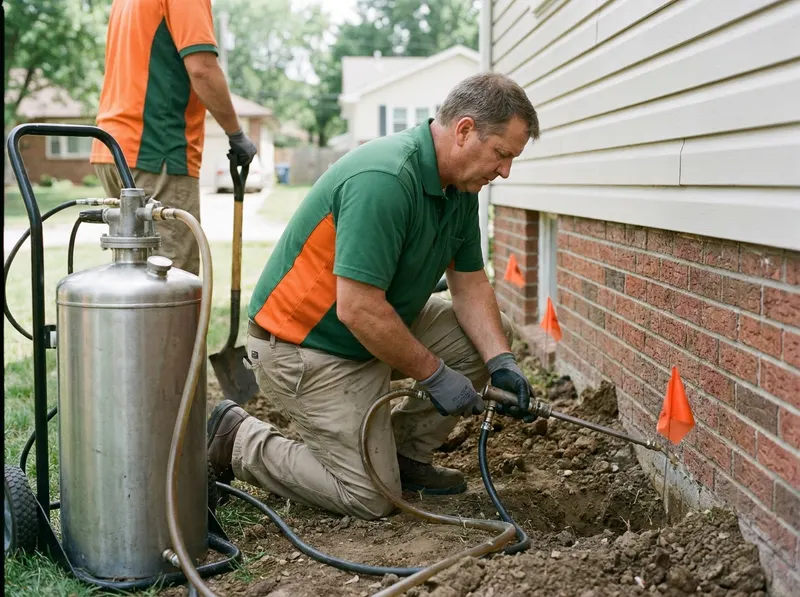
Eastern subterranean termites (Reticulitermes flavipes) cause documented structural wood damage across Douglas County by constructing subterranean mud tubes from damp clay soils directly into foundational framing. Older properties with stone or porous block basements in Dundee, Field Club, and Minne Lusa present high susceptibility along sill plates and rim joists where ground clearance measures narrow. Modern poured-concrete basements common in Millard and Elkhorn develop settling hairline cracks over time, permitting subterranean workers as narrow as 0.5 millimeters to penetrate sub-slab utility penetrations. A termite treatment differs fundamentally from standard insect perimeter sprays: surface sprays fail to affect subterranean workers operating within structural studs or beneath slab floors, requiring concentrated subterranean barrier defense.
Eradication protocols follow two distinct primary methodologies: liquid termiticide barriers and targeted baiting grids. Liquid termiticide application involves trenching exterior soil along the foundational footing to an approximate depth of 6 inches, applying non-repellent chemical agents at roughly 4 gallons per 10 linear feet. When structural footings adjoin finished concrete patios, frequent in Aksarben Village and Morton Meadows bungalows, technicians mechanically drill 0.5-inch access holes spaced every 12 inches to saturate sub-slab soils. The alternative protocol employs in-ground baiting stations installed at 10-foot intervals around the property perimeter. Stations monitor underground foraging tunnels, transferring insect growth regulators back to the reproductive queen without requiring internal drilling. Properties abutting densely wooded river microclimates near Florence or Fontenelle Forest often combine perimeter baiting with foundation barrier treatments to intercept subterranean migrations moving inland.
Remediation begins with a sequential triage procedure: 1. Visual identification maps mud tubes, hollowed wood galling, and discarded reproductive wings near basement window wells. 2. Ultrasonic and moisture instrumentation verifies subterranean activity inside concealed drywall partitions. 3. Exterior trenching or sub-slab drilling delivers EPA-registered termiticide compounds engineered to bind tightly to regional silty clay soils. 4. Interior floor penetrations are sealed with non-shrink structural patching. 5. Follow-up monitoring checks target zones at 30- and 90-day intervals to verify colony elimination. These specialized compounds bind tightly to organic soil particles, ensuring treatments remain active without leaching into domestic plumbing or endangering residential pets and children once dry.
Every job gets a firm, written price after a free on-site visit.
Tell us about your subterranean termite extermination job in Omaha and we'll send a clear, written quote, usually the same day.
 Zenvora Pest Shield